





































Why Indian Cities Struggle to Build Up: Economic Survey Calls Land Dead Capital
Explore why Indian cities struggle to grow vertically as the Economic Survey labels land as “dead capital,” examining policy barriers, regulatory challenges, and economic impacts on urban development.




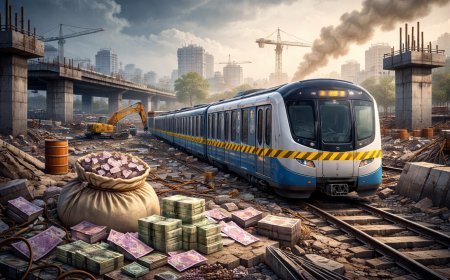
The Economic Survey 2025–26 uses an idea from Peruvian economist Hernando de Soto to explain what's wrong with Indian urban land markets. Capital that is dead.
The Survey says that in economics, "dead capital" means assets that can't be used as productive capital. These are resources that can't help the economy because of rules, laws, or market inefficiencies. The document says that in many Indian cities, land has become dead capital because of a mix of strict land-use rules, title insecurity, broken markets, and speculative incentives that make it hard to recycle land.
The diagnosis is important because land is the most important thing that cities need to improve people's quality of life.
The FSI Limit
The Survey says that India's strict floor space index (FSI) or floor-area ratio (FAR) rules are the most obvious example of this limit. FSI tells you how much building space you can build on each piece of land. A low FSI limits vertical development, so space has to grow outwards instead of up.
The Survey shows some very interesting comparative data. The FSI for Mumbai is about 4. Delhi's FSI is about 3. Pune and Ahmedabad are between 3.5 and 4. Chennai and Kolkata are even lower, at about 2.5 and 2, respectively.
Look at this in comparison to cities around the world. The FSI for Hong Kong is 25. There are 17 in Singapore and 13 in Tokyo. Denver has 17, and New York has 15. Sao Paulo, which is often used as an example of unplanned urban sprawl, has an FSI of 8.
The Survey says that the economic effects are easy to see. When FSI is low, settlements are more likely to grow horizontally. This makes the average cost of land per unit of housing or commercial space go up. It makes it more expensive to build infrastructure. Every extra kilometer of road, water pipe, or power line serves fewer people. It makes people live farther away from work, which makes their commutes longer and lowers their productivity.
The paper says that some state governments and city governments are dealing with this in bits and pieces by giving extra FSI for a fee in certain areas. For example, the Chennai Metropolitan Development Authority is said to be thinking about higher FSI in important areas for its third master plan. This plan would also include mixed-use development and phased upgrades to support compact and vertical growth.
The Survey says, though, that "a holistic rethink will be required for meaningful change at scale." Exemptions that are only partial make things unclear for developers, encourage rent-seeking, and don't lead to the systematic densification that cities need.
The Title Issue
The Survey finds that unclear land titles are the second biggest problem, after density limits. For land to work as capital, it needs to have secure, transferable property rights. They let people use land as collateral, trade it in formal markets, and redevelop it quickly.
There is still a lot of uncertainty about land ownership in urban India. Records are broken up and hard to read. Disagreements are common, and it takes a long time to settle them. The Survey says that this uncertainty makes the effects of low FSI worse by making even allowed development risky and take longer.
The central government has started programs to deal with these problems. The Unique Land Parcel Identification Number (ULPIN or Bhu-Aadhaar) and the National Generic Document Registration System (NGDRS) were both created by the government as part of the Digital India Land Records Modernisation Programme (DILRMP).
State governments have also taken action. The Survey talks about Telangana's Bhu Bharati portal, which brings together the revenue, stamps, and registration departments into one digital platform. It also talks about Karnataka's move toward digital land records under its Bhu Suraksha scheme.
But the paper suggests that these are still works in progress. In most cities, there is still a big difference between legal clarity and ground-level certainty.
The Infrastructure Warning
There is an important caveat in the Survey. Increasing FSI and FAR could make more built-up area per unit of land, which could be good for the economy. But if the necessary infrastructure is not in place, the resulting increase in density will lead to unproductive results.
The document says that "the focus on de-congestion can mislead planners into spreading cities outward instead of building infrastructure to support compact growth, even though successful global cities are dense by design and pair density with robust services."
Things like public transportation, water supply, and sanitation must be important things to think about when making a decision. Without enough infrastructure, more people living in one place will cause traffic jams, water shortages, and sanitation systems that can't keep up. The Survey says that this is why many people say that FSI can't be raised without also improving city services.
This means that land reform and investment in infrastructure must happen at the same time. If we unlock FSI without making Metro networks, water supply, and sewage treatment bigger, we will just make the same problems worse in smaller areas.
The Housing Link
The Survey makes a clear connection between land limits and the lack of affordable housing. It says that the number of homes needed in Indian cities grew from 18.8 million in 2012 to 29 million in 2018, and that 99% of the shortage was in low-income groups. By 2030, the total number of affordable housing units needed is expected to reach 30 million.
The amount of affordable housing in India's top eight cities, on the other hand, has dropped from 52.4% of new supply in 2018 to only 17% by 2025. Developers have moved upmarket, where margins are better, because land costs are high, partly because of FSI restrictions.
The document says that affordable housing is becoming more common in areas on the outskirts because land is cheaper there. But these areas usually don't have enough infrastructure, like bad connections to job centers, bad public transportation, and not enough public services. The Survey says, "While these places have cheap housing, they often lack the basic urban services needed for long-term living."
This leads to a problem. Housing that is cheap but not livable, or housing that is livable but too expensive. The Survey says that breaking this cycle means opening up urban land by allowing higher densities and making sure that land can be used as productive capital.
On January 29, 2026, the Economic Survey 2025–26 was presented to Parliament.
What's Your Reaction?
 Like
0
Like
0
 Dislike
0
Dislike
0
 Love
0
Love
0
 Funny
0
Funny
0
 Angry
0
Angry
0
 Sad
0
Sad
0
 Wow
0
Wow
0