


















IRCTC, IRFC, RVNL Shares Zoom Up to 12% on Railway Fare Increase
Railway fare hikes: The ministry says that fares for sleeper class ordinary and first class ordinary have been changed uniformly at the rate of 1 paise per kilometer for trips that don't go through the suburbs. This means that ticket prices will go up slowly and not too much.

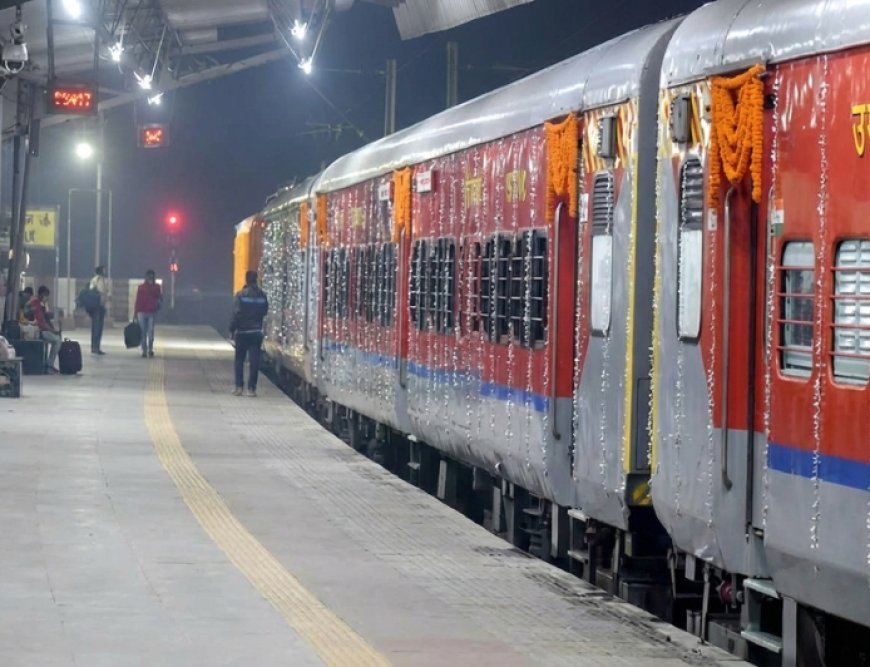

Rail stocks: Shares of rail-related companies like IRCTC, RVNL, and Ircon International, among others, were doing very well in the morning trade on Friday, December 26. This was because the new fares that the government announced go into effect today.
Rail Vikas Nigam (RVNL) shares rose as much as 11.77% to a high of ₹386.40 each on the NSE, and IRCTC shares rose 2.75% to ₹698.35. The price of Ircon International shares rose more than 8% to ₹184.72. RITES was trading at ₹254.44, which was about 5% higher.
Shares of Titagarh Rail Systems rose more than 5% to ₹900.50, and shares of BEML rose 2.4% to ₹1,913.50.
On the NSE, Jupiter Wagons was trading at ₹352.15, which was up 3.39%.
The ministry has changed the prices of passenger trains for the second time this year. In July, the first fare increase took effect.
The ministry said that the goal of rationalizing fares is "to balance affordability for passengers and sustainability of operations."
Here are the facts you need to know
"With the new fare structure, there is no change in fares for suburban services and season tickets, which cover both suburban and non-suburban routes." The ministry said in a statement, "For regular non-AC (non-suburban) services, fares have been made more logical in a graded way across second class ordinary, sleeper class ordinary, and first class ordinary."
It went on to say, "In second class ordinary, there is no fare increase for trips up to 215 km, so short-distance and daily commuters won't be affected." The fare goes up by ₹5 for distances between 216 km and 750 km. For longer trips, the price goes up in steps: ₹10 for distances between 751 km and 1250 km, ₹15 for distances between 1251 km and 1750 km, and ₹20 for distances between 1751 km and 2250 km.
The ministry says that the prices for sleeper class ordinary and first class ordinary have been changed the same way for all non-suburban journeys: 1 paise per kilometer. This will make ticket prices go up slowly and in a limited way.
It said that the fare increase for mail and express trains is now 2 paise per kilometer for both AC and non-AC classes.
"This includes sleeper class, first class, AC chair car, AC 3-tier, AC 2-tier, and AC first class." Passengers will only have to pay about Rs 10 more for a 500 km trip in non-AC mail/express coaches, the statement said.
Where does this apply?
The official notice said that the basic fares for major train services, such as Tejas Rajdhani, Rajdhani, Shatabdi, Duronto, Vande Bharat, Humsafar, Amrit Bharat, Tejas, Mahamana, Gatimaan, Antyodaya, Garib Rath, Jan Shatabdi, Yuva Express, Namo Bharat Rapid Rail, and regular non-suburban services (except AC MEMU/DEMU, where applicable), have been changed to reflect the approved class-wise basic fare increases.
"The new prices only apply to tickets bought on or after December 26, 2025." It also said, "Tickets booked before this date will not have to pay any extra fees, even if the trip takes place after the effective date."
The fare list at stations will also be changed to show the new prices that will go into effect on December 26.
The Railway Ministry says that the last fare increase in July 2025 has brought in ₹700 crore in revenue so far.
Stocks in the railway industry are getting a lot of attention.
Rail stocks have been very busy since the government said it would raise train fares. Also, rail stocks have been in the news because people are interested in how much money the government will give to the sector in the upcoming Union Budget 2026-27 (FY27).
Business daily Mint reports that the Union budget for FY27 may set aside a record ₹1.3 trillion for rail safety. This is almost half of Indian Railways' capital spending and comes as concerns about accidents and the slow rollout of safety systems continue.
What's Your Reaction?
 Like
0
Like
0
 Dislike
0
Dislike
0
 Love
0
Love
0
 Funny
0
Funny
0
 Angry
0
Angry
0
 Sad
0
Sad
0
 Wow
0
Wow
0