


























Why Medical Store Owners Across India Are Protesting
Medical store owners across India are protesting against online pharmacies and regulatory challenges. Explore the key reasons, industry impact, and healthcare policy concerns behind the nationwide agitation.

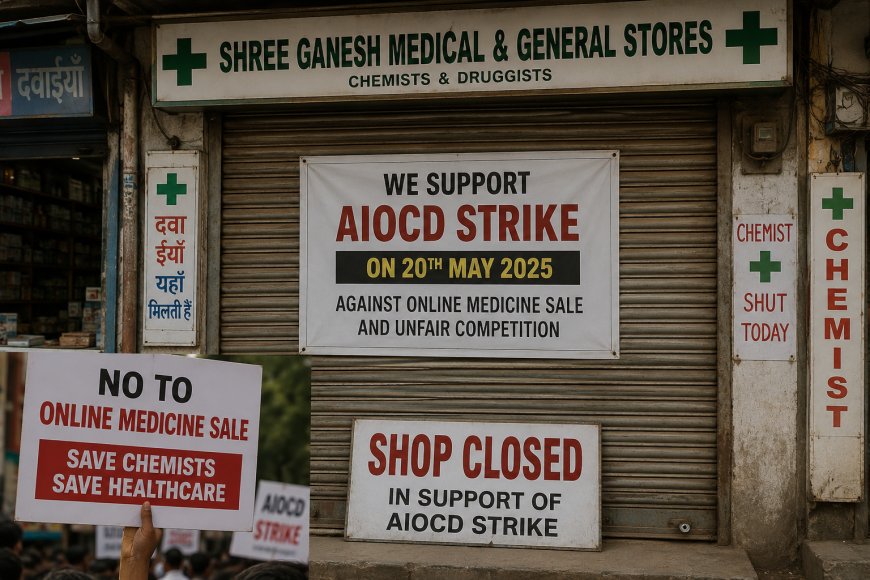


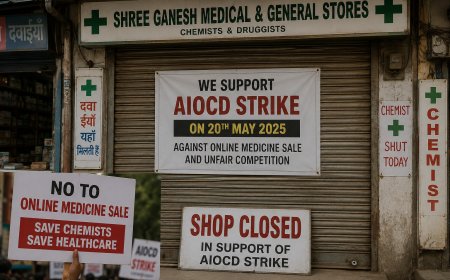
All India Organisation of Chemists & Druggists (AIOCD), which claims representation of about 12.4 lakh chemists, pharmacists, and drug distributors, has called for an all-India strike on May 20, which is likely to impact medicine availability for that day in many places in India.
According to the association, the nationwide strike would be conducted to bring to light loopholes in regulations which have made it possible for e-pharmacies and medicines delivery services to run smoothly.
What is the main demand?
This group has demanded that the government revoke two notifications namely GSR 220(E) and GSR 817(E).
According to this group, these provisions have provided scope for operation of these online pharmacies in a grey zone of legality without any proper regulation regarding how the prescription is authenticated, medicines are distributed and violations are taken care of.
"There is rising apprehension regarding e-pharmacies and instant delivery apps supplying wrong or fake prescriptions. Such instances are due to loopholes in regulations from drug regulator. Yes, e-pharmacies have come to stay, but they need to be regulated equally stringently like conventional pharmacies. That is why we have made a request to government to revoke the GSR 220 E and GSR 817 E notifications which have enabled these pharmacies to exist in legal grey zone," said Rajiv Singhal, general secretary of AIOCD.
What is GSR 817(E)? Why is it being considered as a contentious issue?
GSR 817(E) is a draft notification introduced approximately eight years back, which sought to create a framework of regulation concerning e-pharmacies. In fact, it was aimed at developing a regulatory process for registration, prescription norms, and punitive measures for any violation in operation of online pharmacies.
Unfortunately, this draft has never become a reality because it was neither implemented nor scrapped. According to the pharmacists’ association, the ongoing delay means that e-pharmacies remain unregulated by law. “The review has been going on for years,” explained Singhal on behalf of his association. “It’s an eight-year old draft notification that was neither notified nor withdrawn.”
Why have traditional pharmacists objected to the practice of e-pharmacies?
The association is alarmed by both the issue of patient safety and market competition.
According to the association, some online portals are distributing medicines based on fraudulent or invalid prescriptions, even prescriptions from unregistered physicians. The association has also cited the issue of deep discounting and predatory pricing adopted by large corporates operating through e-pharmacies. “Such deep discounts and predatory pricing of drugs cannot be sustained by small pharmacies; hence this amounts to unfair competition. 'Corporations can make huge profits and then offer such discounts, which is not possible for small shops. This results in unfair competition,'” said Singhal.
Would the strike be a nationwide one?
According to the ministry of health, some state-level pharmacists' associations like that of West Bengal might not join the strike.
However, the national pharmacists' association denies the allegation and claims that the strike would take place all over the nation.
Could there be an interruption in medical supplies?
The chances of a possible delay in the delivery of medicines could arise if a large number of people take part in the strike.
Those dependent on their medicines should try to stock up before May 20.
What's Your Reaction?
 Like
0
Like
0
 Dislike
0
Dislike
0
 Love
0
Love
0
 Funny
0
Funny
0
 Angry
0
Angry
0
 Sad
0
Sad
0
 Wow
0
Wow
0