

























India Eyes Big Role In Shaping AI Future With Mega Tech Chiefs Summit
The India AI Impact Summit 2026 will be held in New Delhi. World leaders, tech moguls, AI founders, and investors are expected to attend. This could be the biggest gathering of AI experts ever.

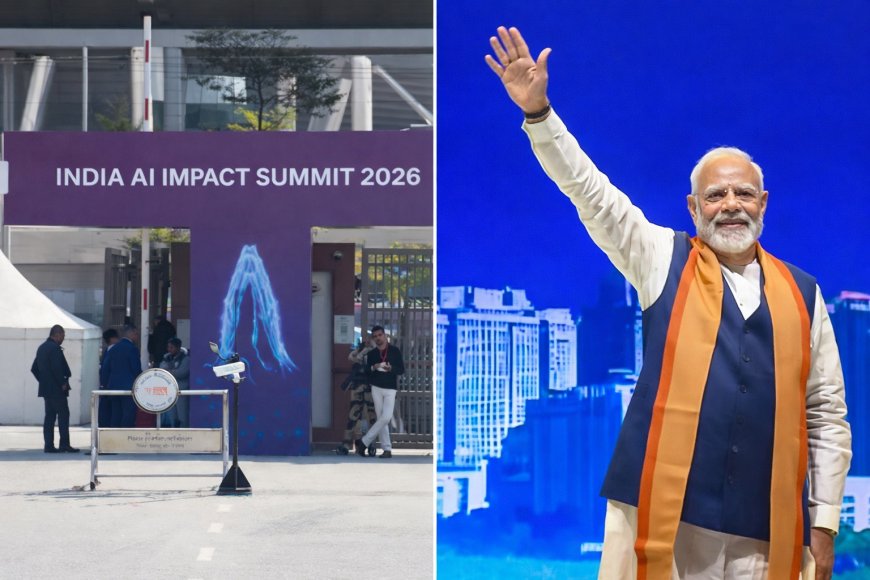


New Delhi: India is hosting one of the largest AI summits in the world on Monday. Prime Minister Narendra Modi wants to help India get ahead in the race to create cutting-edge models.
The India AI Impact Summit is expected to draw world leaders, tech moguls, AI founders, and investors to New Delhi. It could be the biggest gathering of AI experts ever. Sundar Pichai from Alphabet Inc., Sam Altman from OpenAI Inc., Dario Amodei from Anthropic PBC, and Alexandr Wang from Meta Platforms Inc. are all on the guest list. Other guests include researchers like Yann LeCun and Arthur Mensch.
French President Emmanuel Macron will give the main speech on the last two days of the summit, February 19 and 20. Prime Minister Modi will speak after him.
The summit gives PM Modi a chance to show off India's large population of tech-savvy people and engineers as factors that could help India win the next round of the global AI race. A biometric ID system called Aadhaar can identify over a billion people in the country, which powers its digital infrastructure. It has a history of quickly adapting to new technologies, even when it starts late. For example, it missed the personal computer boom but became a software services giant, going from a few landlines to almost a billion smartphones in less than twenty years.
"India is trying to speed up decades of progress by putting AI on top of its existing digital identity, payment systems, health care, education, and government systems," said Abhishek Singh, an extra secretary at the Ministry of Electronics and IT. "And what is made for India won't stay in India."
The country is already selling its plans for digital identity and payments. Countries like the Philippines, Morocco, and Uganda are now using MOSIP, an open-source platform based on Aadhaar's architecture, to build their own national ID systems. Some countries are building digital payment systems on top of the same scaffolding.
According to Stanford University's Institute for Human-Centered AI, India is the third most competitive country in AI, behind the US and China.
Tech companies around the world are paying attention. OpenAI and Anthropic are opening offices in India to attract business customers, developers, and government agencies. Google and Meta are building more data centers to meet the needs of one of the fastest-growing markets for models like ChatGPT, Gemini, and Claude. Nvidia Corp. is feeling the effects of US export restrictions on high-end chips to China, but it sees India as a counterweight. However, its CEO pulled out of the summit at the last minute due to "unforeseen circumstances."
Still, experts in the field warn that India's AI growth may be slowed by years of not investing enough in technology research and development. Aakrit Vaish, who started the AI-focused fund Activate, said that the country's real breakthrough will come from making its research ecosystem stronger so that "we aren't just a testing lab for Silicon Valley's algorithms."
People are already working on making models that fit in with the local culture. This week, systems that reflect India's linguistic diversity will be shown off. Researchers are working on voice-first systems for dozens of Indian languages.
At the summit, BharatGen, which is backed by the government and was created by combining the research power of India's top engineering schools, will show off Param2, a model with 17 billion parameters that supports 22 Indian languages. Lightspeed Venture Partners and Khosla Ventures support Sarvam AI, which will show off an even bigger model that is also voice-first. Both projects want to bring cheap AI to a lot of people and get more data to help change everything from classrooms to clinics to crop fields.
For US companies, growing competition from local models may make it even harder for AI businesses in India to make money, which is a problem for the ecosystem in China.
The focus on affordability is on purpose, and that could change the game. "Our model is meant to speed up adoption in important areas like governance, education, health care, and farming," said Rishi Bal, CEO of BharatGen. "In India and much of the developing world, cost is not an afterthought."
Himanshu Tyagi, co-founder of Sentient AI in San Francisco and backed by Peter Thiel, said that India could catch up if it focuses on things like advanced reasoning for science and robotics. He said this because "the next wave of intelligence will use data not on the internet."
What's Your Reaction?
 Like
0
Like
0
 Dislike
0
Dislike
0
 Love
0
Love
0
 Funny
0
Funny
0
 Angry
0
Angry
0
 Sad
0
Sad
0
 Wow
0
Wow
0