





































Countdown Begins: Artemis II Rocket Rolls to Launch Pad Ahead of April Launch
NASA's Artemis II rocket rolls to the launch pad as the countdown begins for an April launch, marking a historic milestone in humanity's return to the Moon with four pioneering astronauts aboard.

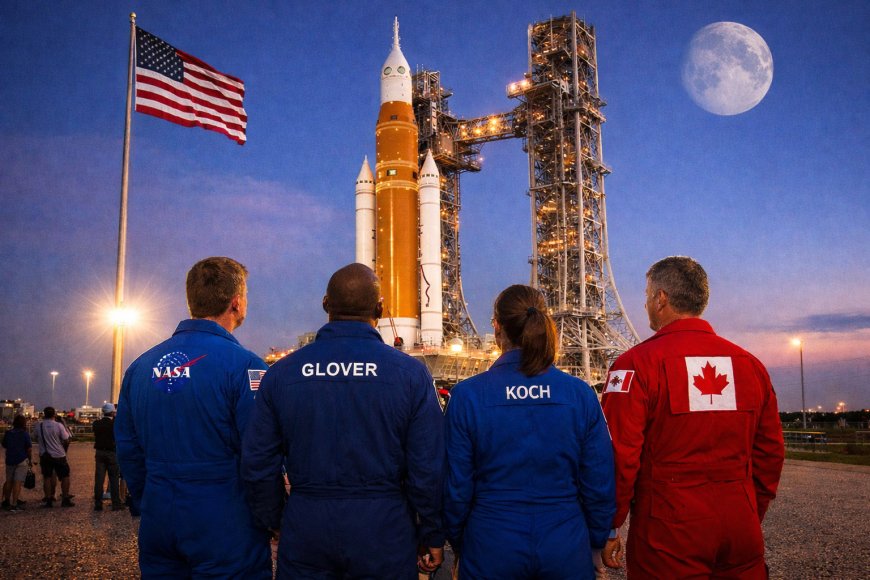


NASA is targeting early April for Artemis II, the first crewed Moon mission in over 50 years. The 10-day journey will take four astronauts further into deep space than ever before, paving the way for a future lunar landing—continuing humanity's exploration beyond the Apollo era of the 1960s and 70s.
Leaks, Delays and a Race Against the Moon's Orbit
NASA has set possible launch dates for Artemis II across early April 2026, with an additional opportunity on the 30th. The mission was originally planned for late 2024 but faced repeated delays—a February attempt was scrapped after a hydrogen fuel leak during a pre-flight rehearsal, while March was ruled out due to a helium leak. Beyond fixing technical issues, planners must also align the launch with the Moon's orbit, creating narrow weekly windows each month
What Will Artemis II's Crew Do in 10 Days?
Artemis II will carry NASA commander Reid Wiseman, pilot Victor Glover, mission specialist Christina Koch, and Canadian Space Agency astronaut Jeremy Hansen—marking the first crewed flight of NASA's powerful Space Launch System rocket and Orion capsule. Once in orbit, the crew will manually test Orion's steering and handling before venturing thousands of miles beyond the Moon to evaluate its life-support, propulsion, power, and navigation systems. The astronauts will also serve as medical test subjects, transmitting health data and imagery from deep space while working in a compact, weightless cabin. Though radiation levels will exceed those on the ISS, they remain within safe limits. The mission concludes with a fiery atmospheric re-entry and a splashdown in the Pacific Ocean off the US west coast.
Beyond Artemis II: NASA's Roadmap to a Permanent Moon Base
Artemis II lays the groundwork for a crewed lunar landing with Artemis IV, planned for 2028 at the Moon's south pole. Before that, Artemis III in 2027 will rehearse Orion's docking with commercial lunar landers—NASA has selected both SpaceX's Starship and Blue Origin's craft, deciding closer to launch which one will fly which mission. Artemis V, also targeted for late 2028, will begin building a sustained human presence on the Moon, with future missions establishing a permanent base, surface modules, and robotic rovers. International partnerships will expand over time, with astronauts from multiple nations living and working on and around the Moon.
NASA's Artemis Mission: Coverage, Access & the Future of Space Exploration
NASA will use a variety of platforms to offer thorough coverage of the Artemis mission. Throughout the launch countdown and mission duration, updates will be posted on the Artemis blog. The public can track Orion in space at nasa.gov/trackartemis, and the most recent imagery will be accessible at Artemis II Multimedia. The public can also sign up to participate virtually in the launch, where they will receive notifications, carefully chosen materials, and a NASA virtual guest passport stamp.
By calling 256-715-9946 with the passcode 682 040 632, media can obtain audio-only launch coverage. Listeners in the Brevard County area can tune into UHF frequency 444.925 MHz or VHF frequency 146.940 MHz. NASA's goals for its Golden Age of exploration include advancing lunar discovery, generating economic benefits, and laying the foundation for future crewed Mars missions.
Introducing the Artemis II Crew
1. NASA Commander Reid Wiseman In addition to overseeing efficient communication and decision-making, the commander guides the crew. As a team advocate, he encourages crew members to voice any concerns or disagreements. Wiseman has been an astronaut for six months and has sixteen years of experience.
2. Victor Glover, Pilot (NASA) Victor Glover is the mission's pilot. He is going to be the first Black person to visit the moon. Glover has been in space for six months and has twelve years of experience.
3. Christina Koch, Mission Specialist 1 (NASA): Christina Koch is a member of the Artemis II crew and a mission specialist. She will be the first woman to visit the area around the Moon. Koch has worked on the International Space Station for a year and has twelve years of experience.
4. Jeremy Hansen, Mission Specialist 2 (Canadian Space Agency), will be the first Canadian to visit the Moon. His first space flight will be on Artemis II.
What's Your Reaction?
 Like
1
Like
1
 Dislike
0
Dislike
0
 Love
0
Love
0
 Funny
0
Funny
0
 Angry
0
Angry
0
 Sad
0
Sad
0
 Wow
0
Wow
0